UAP Files: Maximum Transparency? Pentagon's May 8 Release Promises Much But Fails to Deliver As Yet.

On May 8, 2026, the Pentagon released what was billed as an historic first tranche of declassified files on unidentified anomalous phenomena, or UAP, the government's preferred euphemism for what have long been tagged UFOs. Within 12 hours of its launch, the site had reportedly received approximately 340 million hits. If there was any hope by the Pentagon that this muted release would put the genie back in the bottle, suppressing public interest, the massive public response clearly suggests otherwise.
Hosted on Pentagon website at war.gov/UFO under the absurd title ‘Presidential Unsealing and Reporting System for UAP Encounters (PURSUE)’, the dump comprised roughly 161-162 records: 82 from the Department of War/DoD, 56 from the FBI, 12 from NASA, and a smattering from the State Department. That breaks down to about 120 PDFs, 28 videos, and 14 still images.
President Donald Trump, who directed the effort in a February Truth Social post promising "maximum transparency," hailed it with characteristic bravado:
"Whereas previous Administrations have failed to be transparent on this subject, with these new Documents and Videos, the people can decide for themselves, ‘WHAT THE HELL IS GOING ON?’ Have Fun and Enjoy!"
The White House stressed that past administrations had discredited or dismissed the public’s interest in UAPs while Trump, they asserted, would let Americans "make up their own minds." Secretary of War Pete Hegseth called it "unprecedented," with files to roll out in tranches every few weeks.
Whatever the President’s good intentions, this first tranche release is not disclosure at all. This first release was a curated data dump of mostly low-resolution, context-light material that raises more questions about bureaucratic theatre than extraterrestrial visitors. Some of it was decades old and already in the public domain. It will most certainly not satisfy the public’s demand for answers in the wake of admissions made about retrieved non-human technology by whistleblowers such as David Grusch, Col Karl Nell, Luis Elizondo, Christopher Mellon and many others. The Government needs to be seen to be addressing these allegations directly, not avoiding them.
We are told the best is yet to come but this first tranche release suggests strongly that some anonymous disclosure gatekeeper in the Pentagon and intelligence community intends to play games with an increasingly discerning and demanding public.
There were no admissions or attempts to address allegations of recovered craft in this first release. No non-human biologics. No smoking-gun sensor data proving physics-defying technology. Just the familiar stew of blurry orbs, streaking lights, and "unresolved" reports that have fuelled speculation since the 1940s, without definitive resolution.
The Files: What Was Released and Why It Matters (or Doesn't)
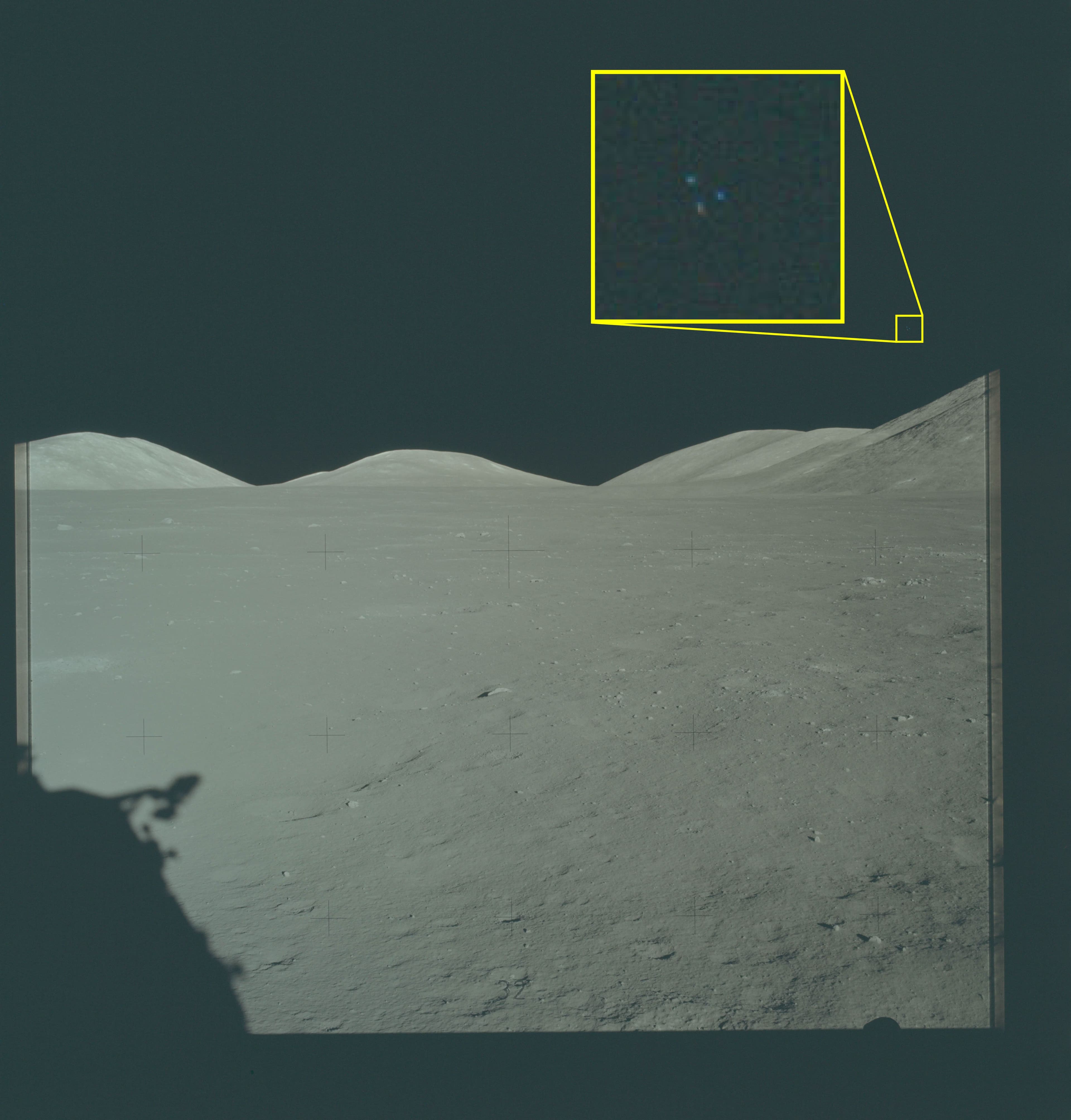
The release spans decades, clustering around military operations and historical milestones. Standouts include NASA Apollo mission imagery and transcripts. Apollo 12 (1969) and Apollo 17 frames show astronaut shadows on the lunar surface with a highlighted "unidentified phenomenon" hovering above the horizon - a bright anomaly. All of the Apollo lunar imagery, showing reported blue light anomalies, was not new – in fact, it has been public information for decades.
But, what was extremely significant however was the Pentagon’s admission about one of those images, a finding that the three-dotted blue lights in a triangular formation captured 54 years ago in 1972 on Apollo 17 imagery hovering over the lunar surface were “potentially physical objects”. It announced:
"As part of the review of historical UAP materials under PURSUE, DOW has opened a case to investigate the accompanying NASA photograph from the Apollo 17 mission, taken December 1972. The image contains three 'dots' in a triangular formation... While this photo has been previously released and discussed by keen observers, there is no consensus about the nature of the anomaly. New preliminary US government analysis suggests the image feature is potentially the result of a physical object in the scene. Additionally, as part of this investigation, the government has obtained the original film from the Apollo 17 mission and the results of the full NASA and DOW analysis will be released when completed."
This is by any measure an extremely significant admission by the Dept of War and it does raise legitimate questions about why NASA’s own recent UAP Independent Study Team, which reported three years ago, was originally tasked with such a narrowly defined scientific advisory role focussed only on terrestrial/aerial anomalies.
Apollo 17 Air-to-Ground Voice Transcript
Apollo 17 Crew Debriefing for Science
This acknowledgment of a potential physical object pairs with Apollo 17 transcripts (a 16-page or multi-page declassified document) describing crew observations of "very bright particles or fragments" tumbling and rotating, with one astronaut comparing the sight to "the Fourth of July out of Ron's window" - "jagged, angular fragments that are tumbling."
The release also includes related Apollo 12 and 17 surface photos with horizon anomalies highlighted similarly.
Since NASA clearly knew about these lunar and orbital anomalies, reported by multiple of its own astronauts, for over 50 years, why then did it not include them within the terms of reference for its own UAP study team? However one spins it, the admission that NASA has had evidence of UAPs for at least half a century does not reflect well on the space agency’s credibility. Was a strategic decision made by NASA to mislead the public by so limiting the terms of reference of its own much-hyped UAP investigation.
Bill Nelson, the NASA administrator at the time of the Study Team’s 2023 report, asserted that the study team, “…did not find any evidence that UAP have an extraterrestrial origin.” Yet, Mr Nelson’s own Study Team was constrained from investigating what the Pentagon now admits half a century later was potentially a physical object.
DOW-UAP-PR46, primary football-shaped image/video, 9-second IR clip
DOW-UAP-PR48, related longer 1:39 IR video from the same command/region
There are curious objects captured in some of the imagery released on May 8. One Reuters-distributed image from the batch depicts a football-shaped body reported by U.S. Indo-Pacific Command (INDOPACOM) in 2024 near Japan: a metallic, elongated form captured in what appears to be optical or radar footage. So much though has been redacted that it is next to impossible to reach any conclusion as to whether the object is genuinely anomalous.
DOW-UAP-PR34, Greece October 2023 primary IR video
DOW-UAP-D33, Greece October 2023 mission report
DOW-UAP-D35, second related mission report
Additional Mediterranean context report
Military reports dominate the DoD files. A 2023 Mediterranean/Greece anomaly appears twice in the same timeframe and location - two separate UAP reports from the same spot, unusual enough to suggest either coordinated sightings or redundant logging of one event. An October 2023 cluster in the region involved unexplained objects amid heightened NATO activity. A 2026 U.S. Army domestic report marks the first acknowledged stateside incident in the batch, shifting from overseas.
September 2023 Ellipsoid Bronze Metallic Object Composite
FBI September 2023 Sighting Composite Sketch
Most of the FBI files released in this first tranche were already public. They include older serials with black-dot photos and composite sketches from witness accounts, some dating to the 1960s-1970s but declassified now. One 2024 composite sketch aggregates multi-observer testimony of an object that defies easy ID.
Western U.S. “Orbs Launching Orbs” Event Slides
DOW-UAP-PR34, Greece/Mediterranean October 2023 IR video
DOW-UAP-D74, Syria bouncy ball mission report
DOW-UAP-PR38, Middle East 2013 eight-pointed star IR video
DOW-UAP-PR46, INDOPACOM near Japan 2024
DOW-UAP-PR48, related longer INDOPACOM IR clip
The videos in this first release - 28 in total - feature infrared and optical clips from operational theatres. Descriptions (the redacted metadata unfortunately limits full analysis) included "orbs" or spheres launching smaller orbs, oval objects streaking at high speeds, a "bouncy ball" manoeuvre at 483 mph, and eight-pointed star-like forms (likely lens diffraction artifacts).
Objects were recorded hovering, then darting with 90-degree turns, or vanishing abruptly. A 2024 INDOPACOM thermal clip of a football-shaped UAP shows it holding position or accelerating in ways pilots described as non-aerodynamic.
Potential anomalies?
Proponents have suggested these videos indicate true UAP: objects demonstrating instantaneous acceleration, transmedium travel (air to space), or defiance of known propulsion without sonic booms or heat signatures. The Greece cluster and Apollo anomalies suggest persistent phenomena across domains - lunar, atmospheric, maritime. The INDOPACOM football evokes classic "Tic Tac" reports: no wings, no exhaust, radar correlation.
The FBI sketches and Army domestic filings imply the issue isn't confined to combat zones or foreign sensors. Collectively, they paint a picture of a 54-year continuum of unresolved sightings, with post-2020 acceleration in documentation - clustering near high-alert areas like the Middle East or Indo-Pacific.
Yet the government attaches disclaimers to every file: "Readers should not interpret any part of this description as reflecting an analytical judgment, investigative conclusion, or factual determination." There are no Pentagon UFO investigation office (AARO – the All-domain Anomaly Resolution Office) conclusions. Just raw reports. The suspicion from many of the Pentagon’s harsher critics is that they chose to dump their least interesting data first, much of it old, in yet another disinformation effort designed to dampen public expectation.
Anomalous?
Based on just this first tranche release, every touted anomaly has potential prosaic vulnerabilities exposed by experts reviewing the batch.
On the Apollo images? Professor Avi Loeb, director of Harvard's Galileo Project, speculated: "The images from Apollo 12 and 17 were fascinating but could be the result of asteroid impacts on the lunar surface" or camera artifacts/reflections. Thousands of Apollo frames exist; none show orbiting craft. He suggested the "highlighted" anomalies were tiny specks in grainy film - consistent with lens flares, dust, or debris from the lander.
The difficulty with Professor Loeb’s analysis is that astronauts saw these same anomalous objects with their human eyeball, not just through a camera lens – notably Apollo 14 Lunar Module pilot Edgar Mitchell. As I reported in my book IN PLAIN SIGHT, Mitchell told friends he saw the blue light objects in lunar orbit during his time on the surface.
On the football-shaped INDOPACOM object? It was blurry, low-res, lacking scale or multi-sensor corroboration in public files. It could be dismissed as a balloon, drone, or sensor glitch - common explanations in prior AARO reports.
The Military IR videos fare no better: the "bouncy ball" and orbs often trace to commercial drones, bird flocks, or infrared artifacts (e.g., "UAP" as hot exhaust plumes). Redacted details on sensor specs, altitude, and speed make verification impossible. The eight-pointed "star" is textbook diffraction spike from optics.
The FBI photos? Black dots on film stock are capable of being dismissed as film defects, distant aircraft, or planets (Venus/Mars frequently misidentified).
Loeb's team verdict: "None of the objects is sufficiently extraordinary to require an exotic origin... all images could be explained as either reflections in the camera optics or human-made objects." Interesting details in videos are redacted.
Leslie Kean, the journalist who broke the 2017 NYT Pentagon UAP story, noted the release proves that government was monitoring and collecting data on UAPs despite official denials of this covert collection until very recently. But, she said, it "doesn't mean we've proven they're alien." A Skeptic magazine review called it "the same old material," with 90-95% of sightings explainable as balloons, planes, birds, or inversions.
The release's strength – volume - is its weakness: curated for public consumption, omitting raw telemetry, pilot interviews, or classified analyses. It is largely transparency theatre: enough to claim "unprecedented" without risking operational secrets.
Trump's directive frames this as populist victory over deep-state secrecy. Pentagon statements align: "The Department of War is in lockstep with President Trump."
Sen. Kirsten Gillibrand (D-NY), a UAP caucus stalwart who secured declassification language in the FY2024 NDAA, issued a measured endorsement: "Transparency is the only path to truth... I am encouraged that the administration has finally heard my call... This is another important step, but there is much more work to do."
What is unique about this disclosure push is that it is bipartisan. Sen. Mike Rounds (R-SD) and Senate Minority Leader Chuck Schumer (D-NY), co-authors of the 2023/2025 UAP Disclosure Act amendments (modelled on JFK records), have long pushed presumption-of-disclosure rules. Schumer has publicly cracked that "the era of government secrecy around UAP is beginning to crack," tying it to bipartisan efforts against obfuscation. Rep. Anna Paulina Luna (R-FL), chair of the House Oversight Task Force on Declassification, called it "a massive first step" and confirmed her requested materials are forthcoming. If the Pentagon follows through by tabling the 46 videos requested by Luna and her UAP caucus colleagues, the next tranche release promises to be much more interesting.
Authentic Disclosure or Diversion?
So, is this the White House's good faith bid to demystify UAPs? Hardly. Trump has weaponized declassification before – the much-touted JFK, RFK, MLK and Epstein files releases failed to live up to expectations. Trump’s timing screams politics; we are months out from the midterm elections and the President is looking to garner whatever political capital he can get amidst an increasingly unpopular Iran War and rocketing oil prices. One social media commentator quipped, "Are there UFOs in the Epstein files?"). A flashy "UFO drop" distracts without cost. No fiscal ask, no interagency turf war - just blurry pics and "you decide."
True disclosure would involve AARO's full caseload, whistleblower protections with teeth, and scientific peer review. It would require a direct denial or confirmation by the US Government as to the truth of claims made by whistleblowers that the United States has operated a covert UAP/UFO craft retrieval and reverse engineering program for many decades. I strongly doubt that will ever happen.
This first tranche feels like a patronising controlled release, designed to dampen expectations: satisfy FOIA pressure and caucus demands while protecting sources/methods. As Kean noted, much more remains classified. Loeb predicts "the best is yet to come" in higher-res recent data - but if past patterns hold, future tranches will echo this one.
What's Next? Luna's 46 Videos and Beyond
Authoritative voices like Loeb and Kean temper hype: this batch proves institutional interest but yields no paradigm shift. As Professor Loeb says: redacted metadata hampers science. Kean observes, the US Government has already admitted UAPs are real; the public knows this and most Americans already believe their Government is concealing what it truly knows.
Rep. Anna Paulina Luna UAP Request Letter
Speculation centres on what are promised to be a series of rolling releases through this Pentagon/Presidential PURSUE initiative. Rep. Luna's March 2026 letter demanded 46 specific AARO-held videos identified by whistleblowers - spanning military branches, including formations over Iran/Persian Gulf, East China Sea, and U.S. domestic airports. Eight have leaked in Jeremy Corbell's documentary Sleeping Dog, showing colour spheres and radar-tracked objects. Representative Anna Paulina Luna has already confirmed the best is yet to come. Expect drone swarms, F-16 intercepts, trans-medium orbs - potentially more compelling if they are recorded on multi-sensor systems.
Congress is likely to push for hearings. But without policy change and serious release of genuinely anomalous imagery, this ‘maximum transparency’ disclosure risks being perceived as drip-feed, merely “feeding the chooks”, as one former Queensland politician with an undisguised contempt for the utility of press conferences frequently opined.
What Would Real Disclosure Look Like?
Most experts - Loeb, Kean - agree: definitive disclosure requires unambiguous evidence of non-human intelligence or technology. Think: recovered craft with exotic materials (isotopes defying Earth geology), biologics with non-terrestrial DNA, or sensor data showing acceleration beyond known physics (e.g., 100g turns without inertia). A single clear, corroborated video of an object violating conservation laws, backed by radar/IR/optics and unredacted metadata. Or a Presidential address with physical artifacts.
Short of that, we're stuck in the residue: unexplained cases after prosaic filters. This May 8 release adds volume to the archive but changes nothing fundamental. Americans deserve better than "have fun and enjoy" with dots in the sky. Until the government releases analysable data - or admits what it can't explain - UAPs risk remaining as mere entertainment, not evidence. The universe is vast; the public wants to see the ‘beef’, the hard evidence. So far, the files fail to deliver.
On May 8, 2026, the Pentagon released what was billed as an historic first tranche of declassified files on unidentified anomalous phenomena, or UAP, the government's preferred euphemism for what have long been tagged UFOs. Within 12 hours of its launch, the site had reportedly received approximately 340 million hits. If there was any hope by the Pentagon that this muted release would put the genie back in the bottle, suppressing public interest, the massive public response clearly suggests otherwise.
Hosted on Pentagon website at war.gov/UFO under the absurd title ‘Presidential Unsealing and Reporting System for UAP Encounters (PURSUE)’, the dump comprised roughly 161-162 records: 82 from the Department of War/DoD, 56 from the FBI, 12 from NASA, and a smattering from the State Department. That breaks down to about 120 PDFs, 28 videos, and 14 still images.
President Donald Trump, who directed the effort in a February Truth Social post promising "maximum transparency," hailed it with characteristic bravado:
"Whereas previous Administrations have failed to be transparent on this subject, with these new Documents and Videos, the people can decide for themselves, ‘WHAT THE HELL IS GOING ON?’ Have Fun and Enjoy!"
The White House stressed that past administrations had discredited or dismissed the public’s interest in UAPs while Trump, they asserted, would let Americans "make up their own minds." Secretary of War Pete Hegseth called it "unprecedented," with files to roll out in tranches every few weeks.
Whatever the President’s good intentions, this first tranche release is not disclosure at all. This first release was a curated data dump of mostly low-resolution, context-light material that raises more questions about bureaucratic theatre than extraterrestrial visitors. Some of it was decades old and already in the public domain. It will most certainly not satisfy the public’s demand for answers in the wake of admissions made about retrieved non-human technology by whistleblowers such as David Grusch, Col Karl Nell, Luis Elizondo, Christopher Mellon and many others. The Government needs to be seen to be addressing these allegations directly, not avoiding them.
We are told the best is yet to come but this first tranche release suggests strongly that some anonymous disclosure gatekeeper in the Pentagon and intelligence community intends to play games with an increasingly discerning and demanding public.
There were no admissions or attempts to address allegations of recovered craft in this first release. No non-human biologics. No smoking-gun sensor data proving physics-defying technology. Just the familiar stew of blurry orbs, streaking lights, and "unresolved" reports that have fuelled speculation since the 1940s, without definitive resolution.
The Files: What Was Released and Why It Matters (or Doesn't)
The release spans decades, clustering around military operations and historical milestones. Standouts include NASA Apollo mission imagery and transcripts. Apollo 12 (1969) and Apollo 17 frames show astronaut shadows on the lunar surface with a highlighted "unidentified phenomenon" hovering above the horizon - a bright anomaly. All of the Apollo lunar imagery, showing reported blue light anomalies, was not new – in fact, it has been public information for decades.
But, what was extremely significant however was the Pentagon’s admission about one of those images, a finding that the three-dotted blue lights in a triangular formation captured 54 years ago in 1972 on Apollo 17 imagery hovering over the lunar surface were “potentially physical objects”. It announced:
"As part of the review of historical UAP materials under PURSUE, DOW has opened a case to investigate the accompanying NASA photograph from the Apollo 17 mission, taken December 1972. The image contains three 'dots' in a triangular formation... While this photo has been previously released and discussed by keen observers, there is no consensus about the nature of the anomaly. New preliminary US government analysis suggests the image feature is potentially the result of a physical object in the scene. Additionally, as part of this investigation, the government has obtained the original film from the Apollo 17 mission and the results of the full NASA and DOW analysis will be released when completed."
This is by any measure an extremely significant admission by the Dept of War and it does raise legitimate questions about why NASA’s own recent UAP Independent Study Team, which reported three years ago, was originally tasked with such a narrowly defined scientific advisory role focussed only on terrestrial/aerial anomalies.
Apollo 17 Air-to-Ground Voice Transcript
Apollo 17 Crew Debriefing for Science
This acknowledgment of a potential physical object pairs with Apollo 17 transcripts (a 16-page or multi-page declassified document) describing crew observations of "very bright particles or fragments" tumbling and rotating, with one astronaut comparing the sight to "the Fourth of July out of Ron's window" - "jagged, angular fragments that are tumbling."
The release also includes related Apollo 12 and 17 surface photos with horizon anomalies highlighted similarly.
Since NASA clearly knew about these lunar and orbital anomalies, reported by multiple of its own astronauts, for over 50 years, why then did it not include them within the terms of reference for its own UAP study team? However one spins it, the admission that NASA has had evidence of UAPs for at least half a century does not reflect well on the space agency’s credibility. Was a strategic decision made by NASA to mislead the public by so limiting the terms of reference of its own much-hyped UAP investigation.
Bill Nelson, the NASA administrator at the time of the Study Team’s 2023 report, asserted that the study team, “…did not find any evidence that UAP have an extraterrestrial origin.” Yet, Mr Nelson’s own Study Team was constrained from investigating what the Pentagon now admits half a century later was potentially a physical object.
DOW-UAP-PR46, primary football-shaped image/video, 9-second IR clip
DOW-UAP-PR48, related longer 1:39 IR video from the same command/region
There are curious objects captured in some of the imagery released on May 8. One Reuters-distributed image from the batch depicts a football-shaped body reported by U.S. Indo-Pacific Command (INDOPACOM) in 2024 near Japan: a metallic, elongated form captured in what appears to be optical or radar footage. So much though has been redacted that it is next to impossible to reach any conclusion as to whether the object is genuinely anomalous.
DOW-UAP-PR34, Greece October 2023 primary IR video
DOW-UAP-D33, Greece October 2023 mission report
DOW-UAP-D35, second related mission report
Additional Mediterranean context report
Military reports dominate the DoD files. A 2023 Mediterranean/Greece anomaly appears twice in the same timeframe and location - two separate UAP reports from the same spot, unusual enough to suggest either coordinated sightings or redundant logging of one event. An October 2023 cluster in the region involved unexplained objects amid heightened NATO activity. A 2026 U.S. Army domestic report marks the first acknowledged stateside incident in the batch, shifting from overseas.
September 2023 Ellipsoid Bronze Metallic Object Composite
FBI September 2023 Sighting Composite Sketch
Most of the FBI files released in this first tranche were already public. They include older serials with black-dot photos and composite sketches from witness accounts, some dating to the 1960s-1970s but declassified now. One 2024 composite sketch aggregates multi-observer testimony of an object that defies easy ID.
Western U.S. “Orbs Launching Orbs” Event Slides
DOW-UAP-PR34, Greece/Mediterranean October 2023 IR video
DOW-UAP-D74, Syria bouncy ball mission report
DOW-UAP-PR38, Middle East 2013 eight-pointed star IR video
DOW-UAP-PR46, INDOPACOM near Japan 2024
DOW-UAP-PR48, related longer INDOPACOM IR clip
The videos in this first release - 28 in total - feature infrared and optical clips from operational theatres. Descriptions (the redacted metadata unfortunately limits full analysis) included "orbs" or spheres launching smaller orbs, oval objects streaking at high speeds, a "bouncy ball" manoeuvre at 483 mph, and eight-pointed star-like forms (likely lens diffraction artifacts).
Objects were recorded hovering, then darting with 90-degree turns, or vanishing abruptly. A 2024 INDOPACOM thermal clip of a football-shaped UAP shows it holding position or accelerating in ways pilots described as non-aerodynamic.
Potential anomalies?
Proponents have suggested these videos indicate true UAP: objects demonstrating instantaneous acceleration, transmedium travel (air to space), or defiance of known propulsion without sonic booms or heat signatures. The Greece cluster and Apollo anomalies suggest persistent phenomena across domains - lunar, atmospheric, maritime. The INDOPACOM football evokes classic "Tic Tac" reports: no wings, no exhaust, radar correlation.
The FBI sketches and Army domestic filings imply the issue isn't confined to combat zones or foreign sensors. Collectively, they paint a picture of a 54-year continuum of unresolved sightings, with post-2020 acceleration in documentation - clustering near high-alert areas like the Middle East or Indo-Pacific.
Yet the government attaches disclaimers to every file: "Readers should not interpret any part of this description as reflecting an analytical judgment, investigative conclusion, or factual determination." There are no Pentagon UFO investigation office (AARO – the All-domain Anomaly Resolution Office) conclusions. Just raw reports. The suspicion from many of the Pentagon’s harsher critics is that they chose to dump their least interesting data first, much of it old, in yet another disinformation effort designed to dampen public expectation.
Anomalous?
Based on just this first tranche release, every touted anomaly has potential prosaic vulnerabilities exposed by experts reviewing the batch.
On the Apollo images? Professor Avi Loeb, director of Harvard's Galileo Project, speculated: "The images from Apollo 12 and 17 were fascinating but could be the result of asteroid impacts on the lunar surface" or camera artifacts/reflections. Thousands of Apollo frames exist; none show orbiting craft. He suggested the "highlighted" anomalies were tiny specks in grainy film - consistent with lens flares, dust, or debris from the lander.
The difficulty with Professor Loeb’s analysis is that astronauts saw these same anomalous objects with their human eyeball, not just through a camera lens – notably Apollo 14 Lunar Module pilot Edgar Mitchell. As I reported in my book IN PLAIN SIGHT, Mitchell told friends he saw the blue light objects in lunar orbit during his time on the surface.
On the football-shaped INDOPACOM object? It was blurry, low-res, lacking scale or multi-sensor corroboration in public files. It could be dismissed as a balloon, drone, or sensor glitch - common explanations in prior AARO reports.
The Military IR videos fare no better: the "bouncy ball" and orbs often trace to commercial drones, bird flocks, or infrared artifacts (e.g., "UAP" as hot exhaust plumes). Redacted details on sensor specs, altitude, and speed make verification impossible. The eight-pointed "star" is textbook diffraction spike from optics.
The FBI photos? Black dots on film stock are capable of being dismissed as film defects, distant aircraft, or planets (Venus/Mars frequently misidentified).
Loeb's team verdict: "None of the objects is sufficiently extraordinary to require an exotic origin... all images could be explained as either reflections in the camera optics or human-made objects." Interesting details in videos are redacted.
Leslie Kean, the journalist who broke the 2017 NYT Pentagon UAP story, noted the release proves that government was monitoring and collecting data on UAPs despite official denials of this covert collection until very recently. But, she said, it "doesn't mean we've proven they're alien." A Skeptic magazine review called it "the same old material," with 90-95% of sightings explainable as balloons, planes, birds, or inversions.
The release's strength – volume - is its weakness: curated for public consumption, omitting raw telemetry, pilot interviews, or classified analyses. It is largely transparency theatre: enough to claim "unprecedented" without risking operational secrets.
Trump's directive frames this as populist victory over deep-state secrecy. Pentagon statements align: "The Department of War is in lockstep with President Trump."
Sen. Kirsten Gillibrand (D-NY), a UAP caucus stalwart who secured declassification language in the FY2024 NDAA, issued a measured endorsement: "Transparency is the only path to truth... I am encouraged that the administration has finally heard my call... This is another important step, but there is much more work to do."
What is unique about this disclosure push is that it is bipartisan. Sen. Mike Rounds (R-SD) and Senate Minority Leader Chuck Schumer (D-NY), co-authors of the 2023/2025 UAP Disclosure Act amendments (modelled on JFK records), have long pushed presumption-of-disclosure rules. Schumer has publicly cracked that "the era of government secrecy around UAP is beginning to crack," tying it to bipartisan efforts against obfuscation. Rep. Anna Paulina Luna (R-FL), chair of the House Oversight Task Force on Declassification, called it "a massive first step" and confirmed her requested materials are forthcoming. If the Pentagon follows through by tabling the 46 videos requested by Luna and her UAP caucus colleagues, the next tranche release promises to be much more interesting.
Authentic Disclosure or Diversion?
So, is this the White House's good faith bid to demystify UAPs? Hardly. Trump has weaponized declassification before – the much-touted JFK, RFK, MLK and Epstein files releases failed to live up to expectations. Trump’s timing screams politics; we are months out from the midterm elections and the President is looking to garner whatever political capital he can get amidst an increasingly unpopular Iran War and rocketing oil prices. One social media commentator quipped, "Are there UFOs in the Epstein files?"). A flashy "UFO drop" distracts without cost. No fiscal ask, no interagency turf war - just blurry pics and "you decide."
True disclosure would involve AARO's full caseload, whistleblower protections with teeth, and scientific peer review. It would require a direct denial or confirmation by the US Government as to the truth of claims made by whistleblowers that the United States has operated a covert UAP/UFO craft retrieval and reverse engineering program for many decades. I strongly doubt that will ever happen.
This first tranche feels like a patronising controlled release, designed to dampen expectations: satisfy FOIA pressure and caucus demands while protecting sources/methods. As Kean noted, much more remains classified. Loeb predicts "the best is yet to come" in higher-res recent data - but if past patterns hold, future tranches will echo this one.
What's Next? Luna's 46 Videos and Beyond
Authoritative voices like Loeb and Kean temper hype: this batch proves institutional interest but yields no paradigm shift. As Professor Loeb says: redacted metadata hampers science. Kean observes, the US Government has already admitted UAPs are real; the public knows this and most Americans already believe their Government is concealing what it truly knows.
Rep. Anna Paulina Luna UAP Request Letter
Speculation centres on what are promised to be a series of rolling releases through this Pentagon/Presidential PURSUE initiative. Rep. Luna's March 2026 letter demanded 46 specific AARO-held videos identified by whistleblowers - spanning military branches, including formations over Iran/Persian Gulf, East China Sea, and U.S. domestic airports. Eight have leaked in Jeremy Corbell's documentary Sleeping Dog, showing colour spheres and radar-tracked objects. Representative Anna Paulina Luna has already confirmed the best is yet to come. Expect drone swarms, F-16 intercepts, trans-medium orbs - potentially more compelling if they are recorded on multi-sensor systems.
Congress is likely to push for hearings. But without policy change and serious release of genuinely anomalous imagery, this ‘maximum transparency’ disclosure risks being perceived as drip-feed, merely “feeding the chooks”, as one former Queensland politician with an undisguised contempt for the utility of press conferences frequently opined.
What Would Real Disclosure Look Like?
Most experts - Loeb, Kean - agree: definitive disclosure requires unambiguous evidence of non-human intelligence or technology. Think: recovered craft with exotic materials (isotopes defying Earth geology), biologics with non-terrestrial DNA, or sensor data showing acceleration beyond known physics (e.g., 100g turns without inertia). A single clear, corroborated video of an object violating conservation laws, backed by radar/IR/optics and unredacted metadata. Or a Presidential address with physical artifacts.
Short of that, we're stuck in the residue: unexplained cases after prosaic filters. This May 8 release adds volume to the archive but changes nothing fundamental. Americans deserve better than "have fun and enjoy" with dots in the sky. Until the government releases analysable data - or admits what it can't explain - UAPs risk remaining as mere entertainment, not evidence. The universe is vast; the public wants to see the ‘beef’, the hard evidence. So far, the files fail to deliver.
